COG tiles as Zarr chunks: what every view has to say about the bytes
A Cloud Optimized GeoTIFF is already a chunked array. Its header lists the byte offset and length of every tile, and a tile is compressed on its own, so one HTTP range request and a decoder give back one block of the array. A byte-reference store turns those header lists into a table (one row per tile: path, offset, size), and each view of the store (kerchunk Parquet, Icechunk, the flat table itself) presents the table to a different kind of reader. Every view then has to say, in its own vocabulary, how a tile’s bytes become values. This page explains what has to be said, using one tile of the GHRSST MUR archive (see the GHRSST example), and where each reader stands.
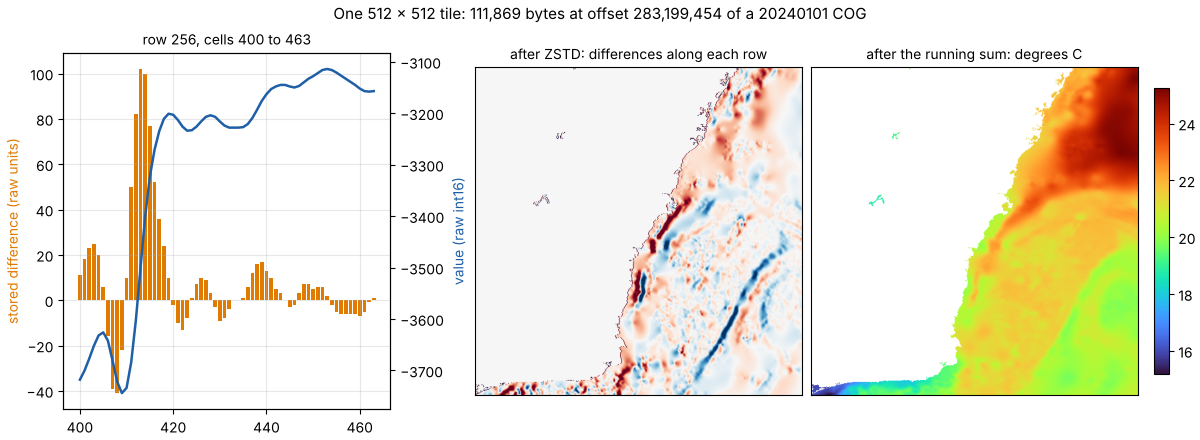
The figure comes from cog-tiles-figure.py, which decodes the tile with nothing but a range request, ZSTD and NumPy.
Two steps per tile
The MUR COGs are written by GDAL with COMPRESS=ZSTD and PREDICTOR=2. A tile is undone in two steps:
Decompress. The tile’s bytes are one ZSTD frame. For an int16 tile of 512 x 512 the result is 524,288 bytes.
Undo the horizontal predictor. TIFF predictor 2 stores each value as the difference from its left neighbour, row by row; the first value of each row is stored as it is. A cumulative sum along each row restores the values. In int16 arithmetic the sum wraps exactly as the encoder’s subtraction did, so no widening is needed:
v = np.frombuffer(zstd_decode(raw), "<i2").reshape(512, 512)
values = np.cumsum(v, axis=-1, dtype=np.int16)
The predictor is why the compressed tile is small: neighbouring sea surface temperatures differ by a few thousandths of a degree, so the differences are small integers near zero (the middle panel), and ZSTD packs them far better than the values. It is also the step a reader most often lacks.
Scale, offset and nodata are not codec steps. They are attributes of the array (scale_factor 0.001, add_offset 25, fill -32768 for analysed_sst), applied after decoding by readers that unpack.
How each view names the steps
| View | Compression | Predictor | Who decodes it |
|---|---|---|---|
| COG (TIFF tags) | Compression=ZSTD |
Predictor=2 |
GDAL’s GTiff driver, async-tiff, tifffile, any TIFF reader with ZSTD |
| kerchunk Parquet (Zarr v2) | compressor zstd |
filter imagecodecs_delta (axis -1) |
zarr-python with imagecodecs’ numcodecs registered; wxy (wxy-predictor); GDAL’s Zarr driver only with a filter plugin |
| Icechunk (Zarr v3) | codec zstd |
codec HorizontalDeltaCodec (the virtual-tiff name) |
zarr-python with that codec registered; wxy; not GDAL yet |
| flat table (mdim-refs) | codec in arrays.json, as the Zarr v2 view |
the same filter, and info per row: COMPRESSION=ZSTD; PREDICTOR=2 |
wxy; a short script (mur_table.py in the example) |
GDAL is the odd one out: it reads the COGs natively, but its Zarr driver does not know either predictor codec. In Zarr v2 it looks up an unknown filter id in its compressor registry, so a small plugin that registers imagecodecs_delta there is enough for it to read the kerchunk view (checked on all five GHRSST windows). Zarr v3 codecs are built into the driver, so the Icechunk view needs a change in GDAL itself. Until then, GDAL and the GDAL-backed xarray readers use the multidimensional VRT view, which points at the COGs and lets the GTiff driver decode. The multidimensional VRT explainer covers what that view costs.
Three things the table has to get right
- Edges. The MUR grid is 17999 x 36000, not a whole number of 512 tiles. TIFF stores edge tiles at full size, and the padding decodes as 0 (25 degrees C once scaled), not as fill. A Zarr reader crops the last chunk to the array’s shape, so the padding never shows, but a reader that pastes whole tiles must crop too. In the 2024 table the bottom row of tiles (rows 17920 to 17999, mostly padding) compresses to 43 bytes.
- Constant tiles. A tile holding one value throughout (all land as fill, or all -1.8 degrees C under sea ice) compresses to 63 bytes. They are 16% of the 2024 table. The size alone tells a planner which tiles hold no information, before any read.
- Change. A day’s COGs are rewritten at the same URL when the final analysis replaces the near-real-time one, and every tile offset in that file moves. A table that records each source’s checksum or etag (the STAC items carry
file:checksumandfile:sizefor rewritten assets) can tell which rows are stale. The VRT is not affected: it names files, not byte ranges.
How this affects wxylib
wxy reads the kerchunk, Icechunk and flat views through wxy-predictor, which implements HorizontalDeltaCodec as a row-wise running sum (wxy-refs maps the kerchunk name imagecodecs_delta onto it), and is checked against GDAL’s hashes of the COGs. The same check is how a new reader of these views earns trust: read the windows of the store’s manifest and compare SHA-256 with GDAL reading the COGs.