Overview selection: gdalwarp’s -ovr AUTO
A Cloud Optimized GeoTIFF carries overviews: the same data at half, a quarter, an eighth of the resolution. A warp to a coarse target does not need the full-resolution cells. Reading an overview instead costs a fraction of the bytes, and the kernel has fewer cells to average. Which overview to read is a rule, and the rule changes the output, because the values in an overview are already averaged. This page explains gdalwarp’s default rule, -ovr AUTO, how wxylib reproduces it, and how the choice is compared with gdalwarp’s.
The code is choose_overview and warp_pyramid in crates/wxy-warp/src/lib.rs in wxylib/core. The GDAL code is the overview choice in apps/gdalwarp_lib.cpp (GDAL 3.12).
The rule
For a target with an explicit extent and size (gdalwarp’s -te and -ts, which is how wxy warp always takes it):
- Measure the target in source cells. Transform a 10 x 10 lattice over the target grid, corners included, back to the full-resolution source, exactly (no approximate transformer). The span of the points in source columns, divided by the target width, is the target’s size in source cells along x; the same for rows along y. The smaller of the two is the ratio to meet: about 4 means each target cell spans about 4 source cells.
- Pick the coarsest level that is fine enough. Each level has a ratio too: full resolution is 1, and an overview is the full width over its width (2, 4, 8 for a typical COG). gdalwarp takes the coarsest level whose ratio is below the target’s ratio plus 0.1, and stops early at a level within 0.1 of it.
- Warp from that level. The overview becomes the source, with its own geotransform, and the warp runs as usual (see how the warper works). Its chunk plan and kernel scale are relative to the overview’s cells, so the kernel is stretched only for what is left of the ratio.
The 0.1 tolerance means an overview slightly coarser than the target can win: a target of 1.9 source cells per target cell reads the half resolution overview, not full resolution. The figure shows the steps for the world fixture: every switch happens 0.1 before the overview’s own ratio.
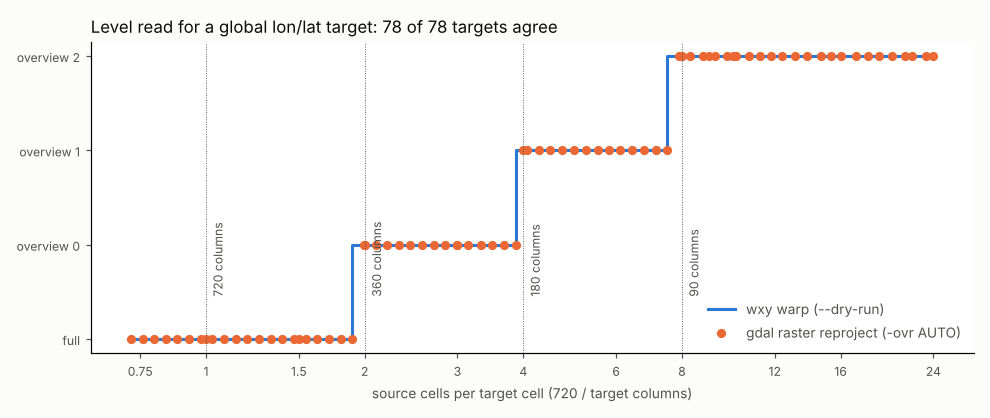
The other -ovr values bypass the rule: NONE reads full resolution, AUTO-n reads n levels finer than AUTO would (full resolution at most), and a number k reads overview k (the first overview is 0).
How wxylib does it
| gdalwarp | wxylib (wxy-warp) |
|---|---|
-ovr AUTO, AUTO-n, k, NONE |
Overview::Auto, AutoFiner(n), Level(k), None (wxy warp --overview) |
| the overview choice | choose_overview |
| warping from the chosen overview | warp_pyramid |
Overview::Auto is the default in WarpOptions and on the command line, as -ovr AUTO is gdalwarp’s default. wxy warp --dry-run prints the plan without reading data, with the level it will read as source.level (0 for full resolution, 1 for the first overview).
Because the choice is made from the transformer and the levels’ widths alone, it costs no reads: the overview headers say how big each level is, and only the chosen level’s chunks are fetched.
How the match is tested
The oracle cases in wxylib/fixtures warp/ include three -ovr AUTO warps (utm-to-4326-ovr, world-to-4326-ovr, polar-to-4326-ovr). For each, the fixture script records the level chosen and GDAL’s warp from that level. cargo test -p wxy-warp (tests/gdal_oracle.rs) requires choose_overview to pick the same level and the warp to give the same values, cell for cell, for nearest, bilinear and cubic.
The fixture script chooses the level with its own port of gdalwarp’s rule. For this page the choice was also checked against GDAL itself: GDAL’s new gdal raster reproject (run through osgeo.gdal’s gdal.Run, GDAL 3.12), whose overview choice is gdalwarp’s -ovr AUTO, reading the level it selects from its debug log. overviews-figure.py does this for 78 global lon/lat targets from the world fixture (the figure). A wider sweep of 41 targets over three fixtures (the world to lon/lat and to polar stereographic, UTM to lon/lat, polar stereographic to lon/lat), run through gdalwarp’s library function, agreed in every case too.