Byte-reference tables: one table, several views
Most archives of gridded data are already chunked. A netCDF4 or HDF5 variable is stored as compressed chunks, a COG as compressed tiles, and each chunk sits at a known byte offset in its file. A byte-reference table writes those positions down, one row per chunk, so the archive can be read as one array without copying it. Every other form of “virtual Zarr” (kerchunk, Icechunk virtual references, a multidimensional VRT) is a rendering of the same rows. This page explains what the table holds, how a reader finds one chunk in it, what each view is for, and what a table has to state so that its readers agree.
The format is the shared mdim-refs/0.2 spec; wxylib reads it and does not own it. The reader is wxy-refs in wxylib/core.
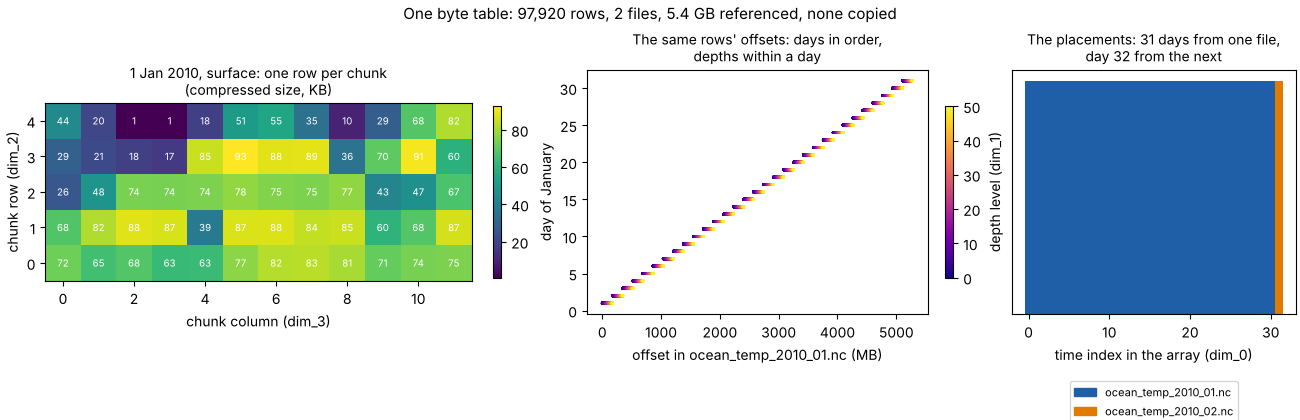
The figure comes from byte-tables-figure.py, which reads the 32-day BRAN2023 table in wxylib/fixtures with nothing but Parquet.
A row
A row says where one chunk’s bytes are:
dim_0 .. dim_3 |
present |
path |
offset |
size |
info |
|---|---|---|---|---|---|
| 0, 0, 0, 0 | 1 | .../ocean_temp_2010_01.nc |
46353 | 74186 | COMPRESSION=DEFLATE; FILTER=SHUFFLE; ENDIANNESS=LITTLE |
The dim_ columns are the chunk’s key in the array’s chunk grid (day, depth, chunk row, chunk column here). A reader that wants that chunk asks the server for size bytes starting at offset, then decodes them with the codec that info names. Nothing else is needed: no netCDF library, no HDF5, no file open.
A chunk is in one of three states:
- referenced:
present = 1, withoffsetandsize; - inline:
present = 1, with the bytes themselves indata(small arrays such as coordinates); - absent:
present = 0, never written by the producer; a reader returns the array’s fill value.
A key with no row at all means the source was not scanned. That is an error, not a fill: the difference between “known empty” and “not looked at” is kept in the table.
Three layers
A table over many files is built from three layers, each held once.
Physical. For each source file, the byte range of every chunk, keyed by the chunk’s position within that file. This is what a scan of one file returns (GDAL’s raw block info, an HDF5 chunk walk, a TIFF’s tile offsets). It knows nothing about the dataset the file belongs to.
Plan. Where each file’s part sits in the whole array: in the figure, the January file supplies days 1 to 31 and the February file day 32. These are the
<Source>entries of a GDAL multidimensional mosaic VRT (source slab and destination offset), copied into the table so it stands on its own.View. The global chunk index, one row per chunk of the whole array, computed from the first two. For each axis,
global key = key in source - source offset / chunk + destination / chunkThe published Parquet export (
refs_<array>.parquet) is this view.
Keeping them apart is what makes a table maintainable. A rescanned file changes only its own physical rows. A file that moves changes only a path rewrite (the remap table, applied at publish or at read, as wxy warp --remap). A new day appends one file’s rows and one placement.
Finding one chunk
Filtering the view on a computed key scans every row. For a single chunk the lookup runs the other way: find the placement whose destination slab holds the key, subtract to get the key within that source, and look the row up by its primary key. On a table of about a million chunks that is under a millisecond, against one to two seconds through the view.
wxy-refs reads the published view. It loads the rows for the arrays it opens and serves them to zarrs as storage: a present row becomes a range request through object_store (local files, HTTP(S), S3), an inline row returns its bytes, an absent row reads as fill. A table of tens of millions of rows does not yet fit this load-everything approach; lookup by row group is the next step for it.
The views, and who reads them
| View | What it is | Read by |
|---|---|---|
mdim.vrt |
the plan as GDAL XML: which file supplies which slab | GDAL, osgeo.gdal, GDAL’s xarray backend |
flat (refs_<array>.parquet and arrays.json) |
the view rows and the array metadata | wxy, DuckDB, R and Python with only Parquet and HTTP, the browser |
| kerchunk Parquet | the same rows in fsspec’s reference layout | xarray through fsspec, GDAL (/vsikerchunk_parquet_ref/), wxy |
| Icechunk | the rows as virtual chunk references in a versioned repository | the Icechunk and xarray stack, wxy |
The views agree in bytes. On the BRAN2023 and GHRSST MUR stores, wxy reads the flat, kerchunk and Icechunk views and gets the same values as GDAL reading the mdim.vrt, window for window. They do not agree in who can read them: GDAL’s Zarr driver cannot decode the TIFF predictor that MUR’s tiles use, so GDAL users go through the VRT there (see COG tiles as Zarr chunks). The VRT is the slowest to start on a long series, because GDAL opens source files to plan a read (see Multidimensional VRT views), and the table views start in under a second. That is why a store publishes all of them: the VRT as the oracle and GDAL’s way in, the table as the fast and portable one.
What a table has to state
A reader can only be as right as the description it is given. The metadata in arrays.json (data type, fill, chunk shape, codec, CF attributes) is copied from the source at harvest, and every reader trusts it. Two things go wrong in practice:
- Rounded packing. A
scale_factorwritten with too few digits (0.0078where the source file has0.0077822199) decodes every value about half a degree too cold in BRAN’s temperature, in every reader at once, because they all agree with the table. Comparing the table’s attributes with the source file’s catches it; comparing readers with each other does not. - Two fills. A CF
_FillValuein the attributes and a format fill for absent chunks are different things. A reader keeps the CF value for masking and uses the format fill only where no chunk exists.
The checks belong at the producer’s publish step: attributes against the source, one window against GDAL, and the VRT’s source slabs complete. The design note m17 has the full contract.
In wxylib
# a local table directory, or an s3:// prefix holding one
wxy warp --crs EPSG:3031 --extent -4e6 -4e6 4e6 4e6 --size 800 800 \
  --source-array /temp --remap public  path/to/store/flat  out.zarr
wxy warp,wxy pointsandwxy zonaltake a table (the flat export or a kerchunk Parquet store) as their source.wxy warp --remap TARGETrewrites source paths through the table’sremaprows (a mirror, or local copies).wxy warp --cache DIRkeeps the bytes each run fetches (see Keep the bytes a run reads).--dry-runprints the chunk keys a run will fetch before any is read.
Worked examples: a month of OISST, a year of BRAN2023 and the MUR SST archive.