wxylib
GDAL’s modular ideas as small Rust crates, checked cell for cell against GDAL
wxylib takes the ideas inside GDAL (grids, georeferencing, chunked reads, warping, virtual datasets), gives each one its own small home, and builds on existing crates (async-tiff, zarrs, Icechunk, rwarp) rather than replacing them. It is pre-release: nothing is on crates.io yet and APIs will change.
Start here
Install the wxy command or a container image, warp a COG to the Antarctic, then follow a month of real sea surface temperature from NOAA’s bucket as virtual Zarr.
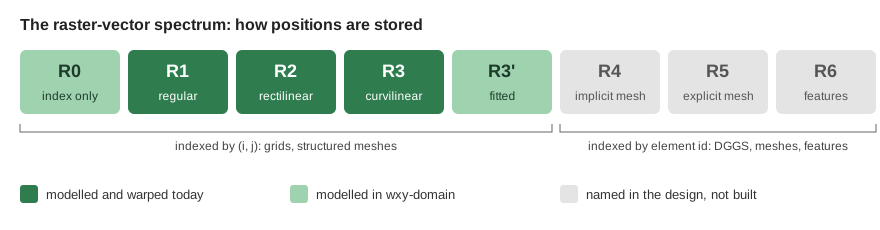
Capability map
Which rungs of the ladder are built, which verbs work on each, and what each way in (Rust, CLI, Python, R, browser) can do today.
How-tos
Short answers to questions people ask on forums: a COG in any projection, a curvilinear grid to a polar map, values at points, zonal statistics.
Explainers
How each GDAL mechanism wxylib ports works, in GDAL and in wxylib, and how the two are checked against each other.
Live demos
The warper compiled to WebAssembly: a COG or Sentinel-2 scene warped in the browser on every pan and zoom.
Reference
The crates, the wxy command, the Python and R packages, and the byte-reference table spec.
Design
The module survey, the data model, the architecture and staged roadmap, related work, and the musings that are not plans yet.
Gaps and contributing
What does not work yet, where help counts most, and how to pin a behaviour down with a fixture.
Companion reading
wxylib’s grid model comes from two of its author’s projects: Regular in what?, a short book on grids, coordinates and the curvilinear confusion, and playproj, map projections, cells and index space drawn the way they are built.