How the warper works: chunks, windows and kernel scale
A warp fills a target grid with values from a source grid in another projection: for every target cell, find where its centre lands in the source and resample there. Written that way it is one loop. GDAL’s warper does more than the loop, and the extra steps decide the numbers it writes. This page explains those steps, where each one lives in wxylib, and how the two are kept identical.
The code is wxy-warp (crates/wxy-warp/src/chunked.rs) and wxy-resample in wxylib/core. The GDAL code it ports is alg/gdalwarpoperation.cpp and alg/gdalwarpkernel.cpp (GDAL 3.12).
The steps in GDAL
The transformer. Target pixel positions go to source pixel positions through the CRS transform, wrapped in GDAL’s approximate transformer. Along each run of points (a scanline, or an edge of a window) it transforms the two ends and the middle exactly; if the middle is within 0.125 pixels of the straight line between the ends it interpolates the rest linearly, otherwise it halves the run and tries again. So the result depends on where each run starts and ends.
The chunk list (
CollectChunkList). The target is not warped in one piece. GDAL computes the source window the whole target needs, and splits the target in half, along its longer side, when either- the source window plus the target would exceed the warp memory limit (64 MB by default), or
- the window is less than half full of real source cells (the window’s bounding box runs off the source) and the chunk is more than 100 cells along either side.
Each half is then treated the same way, recursively.
The source window of a chunk (
ComputeSourceWindow). GDAL transforms 21 points along each edge of the chunk back to the source and takes their bounding box. If any of those points fail (they fall outside the projection’s domain), or the target contains a pole, it samples a 23 x 23 grid over the chunk instead, and also transforms a 23 x 23 grid of source points forward to catch source cells that land inside the chunk but are missed by the backward sample. The box grows by the kernel’s radius (more when the kernel is stretched, step 4, and by 10 cells when any point failed), and a window covering more than 90% of the source width or height takes all of it.The kernel scale (
GDALWarpKernel::PerformWarp). The ratio of a chunk’s target size to its source window size says whether the target is coarser than the source. If it is (a ratio below 1), bilinear and cubic kernels are stretched by that ratio so each target cell averages over all the source cells under it, rather than sampling four or sixteen of them. A ratio within 0.05 of 1/n snaps to 1/n.The kernel loop. For each target cell in the chunk, GDAL transforms its centre, checks it lands in the window (retrying with the exact transformer for points just outside,
GWKCheckAndComputeSrcOffsets), and resamples with the chunk’s scaled kernel. With nodata, invalid source cells are skipped and the kernel’s weights renormalised; at the edge of the projection’s domain a valid neighbour stands in for an invalid cell (GWKAdjustSrcOffsetOnEdge).
What it looks like
The world fixture (0.5 degree lon/lat) warped to a 2000 x 2000 south polar stereographic grid, with the memory limit lowered to 1 MB so that the chunking shows at this size. The target splits into 13 chunks (left); each reads only its own source window (right). The four chunks around the pole see every longitude, so their windows take the whole width, as does chunk 12, which straddles the 180 degree meridian (straight down from the pole).
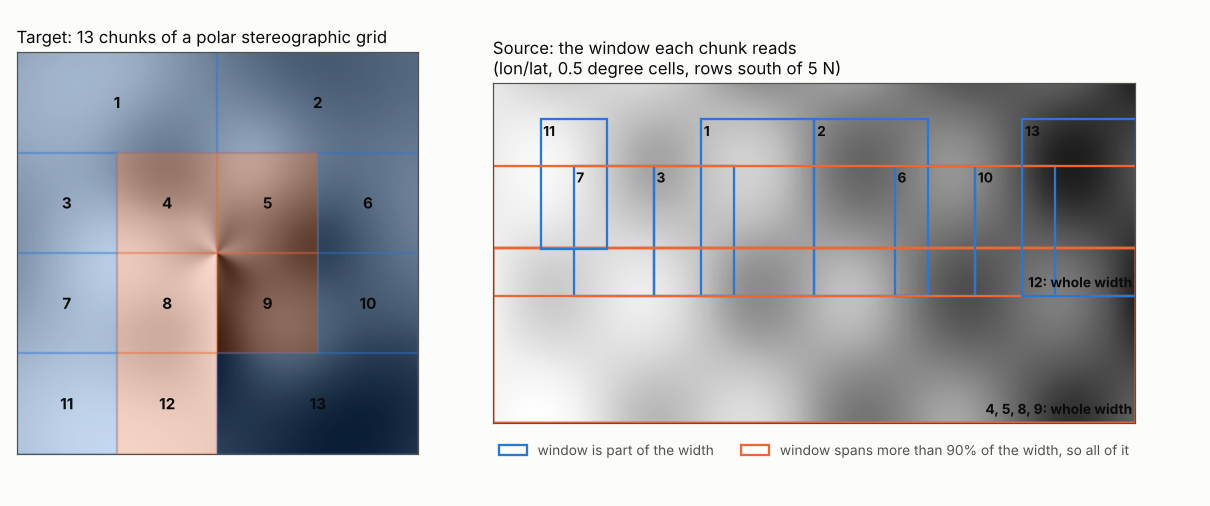
The chunk list is GDAL’s (gdalwarp -wm 1, through osgeo.gdal), read from its debug log by warper-chunks.py. wxy warp ... --wm 1 --dry-run prints wxylib’s plan (warp_chunks), which has the same 13 chunks and windows, and the warp itself gives GDAL’s values in all 4,000,000 cells for nearest, bilinear and cubic.
Why the chunks matter to the values
If the chunks only saved memory, any chunking would do. They also change the output:
- Kernel scale is set per chunk from its window (step 4). A chunk whose window is a little wider gets a slightly different stretch, and different bilinear and cubic values.
- Window edges clip the kernel: a cell near a window edge sees fewer source cells than it would in a larger window.
- Approximation runs follow chunk rows (step 1), so where the transformer interpolates, and where it falls back to exact transforms, depends on the chunk’s extent.
So matching GDAL cell for cell means planning the same chunks, the same windows and the same scales, not just using the same kernels.
How wxylib does it
The port keeps GDAL’s steps and their arithmetic order, as plain functions over a transformer:
| GDAL | wxylib (wxy-warp, chunked.rs unless noted) |
|---|---|
GDALApproxTransform |
rwarp’s ApproxTransformer, wrapped in Approx (lib.rs) |
CollectChunkList |
Planner::chunks |
ComputeSourceWindow |
Planner::source_window |
ComputeSourceWindowTransformPoints |
Planner::sample |
ComputeSourceWindowStartingFromSource |
Planner::probe_source |
kernel scale in PerformWarp |
chunk_scale, Scale::ratios (wxy-resample) |
GWKCheckAndComputeSrcOffsets |
src_offset |
GWKAdjustSrcOffsetOnEdge |
adjust_on_edge |
| warp kernels (nearest, bilinear, cubic) | Kernel::value, Kernel::density (wxy-resample) |
Two things are organised differently, without changing the values:
- Planning is separate from reading.
WarpPlanruns the chunk planner once, takes the union of the chunk windows, and fetches that region as whole source chunks (COG tiles or Zarr chunks). Any leading dimensions (time, depth, band) are then warped slice by slice under the same plan, so a 4D store streams through without being loaded. - The kernels have no I/O and no transforms.
wxy-resampletakes a window of cells and a position in it, and nothing else; the chunk loop inwxy-warpsupplies both (see the kernels).
And a few things differ on purpose, each with a switch:
- A source covering 360 degrees of longitude wraps: target cells past its edge read the other side, and pole rows are read rather than left empty.
--no-wrap(CLI) gives GDAL’s behaviour. --plainwarps in one pass through rwarp with a 1:1 kernel, skipping the chunk plan: faster on large targets, but bilinear and cubic then sample rather than smooth a coarser target.
Not ported: GDAL’s retry with CHECK_WITH_INVERT_PROJ for windows with wild values (a PROJ switch the pure-Rust proj4rs backend does not have), destination alpha, cutlines, and source masks other than nodata.
How the match is tested
GDAL is the oracle. wxylib/fixtures holds small source files and what GDAL’s warper writes for them (scripts/make_warp_fixtures.py, through rasterio with the approximate transformer at its default 0.125 pixel threshold). There are 13 source and target pairs, each with nearest, bilinear and cubic: global to Antarctic polar stereographic, polar to lon/lat, a 0 to 360 source across its seam, a source with nodata, UTM to lon/lat at 1:1 and coarser, and targets that read from overviews. Two of them split into chunks: polar-to-4326-global into 16, because most of its target misses the source (the fill ratio rule), and world-to-3031-wm1 into 4, with the memory limit at 1 MB (WarpOptions::memory_limit, wxy warp --wm, gdalwarp’s -wm). cargo test -p wxy-warp (tests/gdal_oracle.rs) warps each and compares with GDAL’s output. The bar is identity: every cell, every case.
Larger splits were checked for this page:
- The chunk list. For five target grids (polar stereographic targets of four extents from the world fixture, and the polar fixture to lon/lat; nearest, bilinear and cubic), wxylib’s chunks and windows were the same as GDAL’s debug log at a 1 MB memory limit, between 8 and 44 chunks each.
- The values. warper-check.py warps the polar fixture to a 3000 x 600 lon/lat grid, which GDAL splits into 44 chunks at its default settings, with
wxy warpand with GDAL’sgdal raster reproject. All 1,800,000 cells are identical for nearest, bilinear and cubic.
near     GDAL chunks:  44  cells differing: 0 of 1800000
bilinear GDAL chunks:  44  cells differing: 0 of 1800000
cubic    GDAL chunks:  44  cells differing: 0 of 1800000